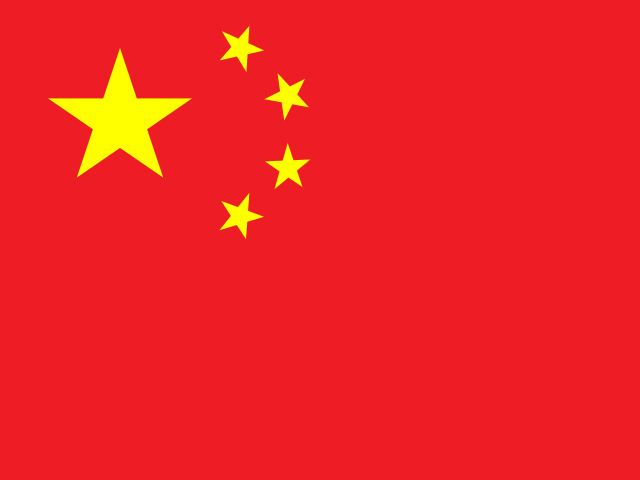
 China
ChinaBottom Line
The diminished coordination capacity of the G7 summit and the accelerated repatriation of gold by global central banks reflect weakening cohesion within the Western bloc and rising geopolitical risk aversion. However, the stable strategic relationship between China and Russia provides investors with a relatively moderate geopolitical environment in Asia. It is recommended that investors with exposure to China's IT, mining, and energy sectors focus on the boost to gold mining stocks from central bank gold purchases, as well as the support for energy and mining supply chains from stable Sino-Russian relations.
Key Developments
-
G7 Summit Exposes 'Lowest Common Denominator' Dilemma of Western Alliance — The G7 summit, which opened on June 15, 2026, in Évian-les-Bains, France, has been described by foreign media as lacking representativeness and agenda coordination capacity, with the group's influence in the global geopolitical landscape continuing to decline. Investment relevance: Weakened Western coordination reduces the risk of unified sanctions against China, benefiting Chinese technology and energy companies in maintaining existing international market access.
-
Global Central Banks Accelerate Gold Repatriation to Hedge Geopolitical Risks — The World Gold Council's annual survey shows that amid rising geopolitical tensions, central banks continue to repatriate gold reserves from overseas and are expected to increase their gold holdings further. Investment relevance: The central bank gold-buying spree directly benefits the mining sector (especially gold mining companies), while also suggesting heightened investor sensitivity to sovereign risks, potentially driving capital flows toward hard assets.
-
Strategic Analysis Suggests Russia Will Not Pose a Geopolitical Challenge to China — Based on dimensions such as border stability and the gap in national power, analysis indicates no major strategic conflict between China and Russia, and Russia is unlikely to become a strategic competitor to China in the future. Investment relevance: Stable Sino-Russian relations reduce the political risk of China's energy and mining projects (e.g., northern oil and gas pipelines, mineral cooperation), enhancing the expected stability of related supply chains.
Sector Implications
| Sector | Impact | Key Concern |
|---|---|---|
| IT | Neutral | Fragmentation of global technology alliances, but weakened G7 coordination makes export control risks temporarily manageable |
| Mining | Positive | Central bank gold repatriation directly benefits gold mining companies; stable Sino-Russian relations safeguard critical mineral cooperation |
| Energy | Neutral | Stable Sino-Russian energy relations, but global geopolitical tensions may trigger oil price volatility |
Details:
- IT: Weakened internal coordination within the G7 means that U.S.-led joint technology export controls are harder to secure unanimous support, alleviating short-term risks of escalated sanctions against Chinese tech companies. However, unilateral actions by individual countries require attention.
- Mining: Continued gold purchases by global central banks will provide structural demand support for gold mining companies; stable Sino-Russian relations further consolidate China's mining interests in Russia, reducing the risk of politicization of mining rights.
- Energy: Sino-Russian strategic mutual trust ensures the fulfillment prospects of long-term energy contracts such as natural gas pipelines, but the G7 may impose new restrictions on Russian energy exports, indirectly increasing pricing uncertainty for China's energy imports.
Geopolitical Pulse
| Indicator | Assessment | Trend |
|---|---|---|
| Diplomatic Climate | Stable | Improving |
| Sanctions Risk | Low | Stable |
| Regional Stability | Stable | Stable |
| Key Dynamic | “Risk aversion repatriation and alliance fragmentation” | — |
Risk Watch
-
Risk of Unified G7 Action Against China — Although internal coordination within the G7 is weakening, the group may still reach a minimum consensus on key issues (e.g., technology transfer, financial systems), triggering unexpected tightening after partial sanctions relaxation. Timeline: Medium-term. Probability: Medium.
-
Risk of Transmission from Russia's Declining National Power — Analysis suggests that while the widening gap in national power between China and Russia reduces strategic challenges, Russia's sustained economic pressure may lead to its failure to fulfill long-term energy and mineral contracts, affecting China's related investment returns. Timeline: Long-term. Probability: Low.
-
Liquidity Preference Shift Triggered by Central Bank Gold Repatriation — If central bank gold purchases exceed expectations, it may accelerate capital outflows from stock and bond markets, raising financing costs and indirectly affecting the financing environment for China's mining sector. Timeline: Near-term. Probability: Medium.
Outlook
Key dates and events to monitor:
- Details of the G7 summit's follow-up statement (released after June 15, 2026) regarding whether it includes a unified stance on China
- World Gold Council's next quarterly gold purchase data release (expected August 2026)
- Announcements related to new arrangements for cross-border trade settlement between China and Russia (e.g., progress in local currency settlement)
Strategic consideration: The decline in G7 cohesion provides a short-term window for China, but global central bank risk-averse behavior may reshape asset pricing logic; mining benefits from demand for hard assets, while IT and energy require attention to marginal changes in unilateral sanctions and contract performance.