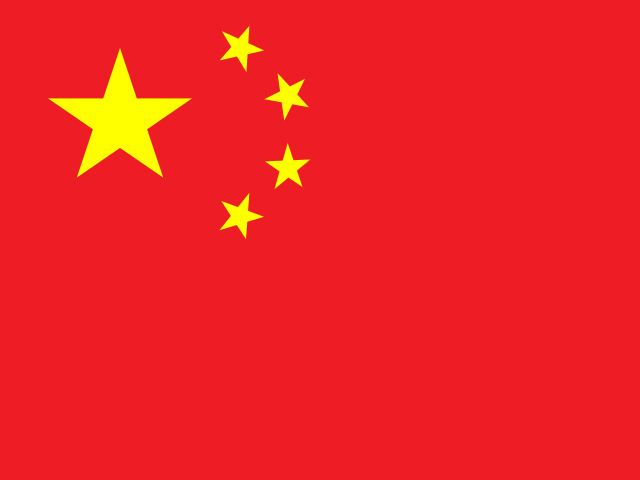
 China
ChinaBottom Line
From late February to early March 2026, China faces challenges and opportunities on multiple geopolitical fronts: signaling exchange rate stability by removing the foreign exchange risk reserve requirement, while adopting a firm stance against the US and Japan in trade and technology, and confronting direct supply chain and energy security risks due to Panama's takeover of a Chinese-funded port and escalating Middle East tensions. Investors should closely monitor the dynamic evolution of quadrilateral trade relations among China, the US, Europe, and Japan; the stability of critical supply chain nodes; and the potential impact of Middle East conflicts on global energy prices and shipping security.
Key Developments
-
US Supreme Court Rules "Reciprocal Tariffs" Illegal, China Urges Repeal — In response to the US Supreme Court's February 20 ruling that the "reciprocal tariffs" and fentanyl-related tariffs from the Trump era are unlawful, China's Ministry of Commerce made multiple statements on February 23 and 24, urging the US to repeal the relevant unilateral tariff measures. Investment Relevance: This event presents a potential turning point in China-US trade relations. If subsequent US actions cancel or reduce these tariffs, it could alleviate cost pressures for Chinese exporters, particularly in manufacturing sectors previously affected by tariffs (e.g., machinery, electronics, chemicals), improving profit prospects for related industries. Investors need to monitor the US government's subsequent policy responses.
-
China Adds 20 Japanese Entities to Export Control List — On February 24, citing concerns over Japan's "remilitarization," China's Ministry of Commerce added 20 Japanese entities, including subsidiaries of Mitsubishi Group and the Japan Aerospace Exploration Agency (JAXA), to its dual-use items export control list. Investment Relevance: This move signifies the public escalation of technological competition and security friction within Sino-Japanese bilateral economic and trade relations. Directly affected are Chinese suppliers involved in exporting high-end materials, precision components, and potential dual-use technologies to Japan. More broadly, this action heightens the risk of fragmentation in global high-tech supply chains. Japanese-funded high-tech manufacturers in China and Chinese enterprises reliant on key Japanese equipment and materials need to assess potential supply chain disruptions.
-
Panamanian Government Forcibly Takes Over Port Operated by CK Hutchison — Between February 23 and 27, the Panamanian government, via a Supreme Court ruling and administrative decree, forcibly took over key Panama Canal ports (Balboa and Cristóbal) operated by a subsidiary of Hong Kong's CK Hutchison Holdings. China's Ministry of Foreign Affairs expressed opposition, stating it disrupts international trade. Investment Relevance: This poses a significant challenge to China's overseas critical infrastructure investments. The event directly impacts CK Hutchison's assets and operations and may trigger a market reassessment of political risks for Chinese investments in other Latin American and Belt and Road Initiative countries. Logistics and shipping costs may rise in the short term due to operational transition uncertainties. Investors should monitor China's diplomatic countermeasures and their impact on the confidence of Chinese enterprises in global expansion.
-
Middle East Situation Escalates Sharply with US-Israel Strikes on Iran — On February 28, the US and Israel launched military strikes against Iran. China's Ministry of Foreign Affairs and its Permanent Representative to the UN expressed serious concern on February 28 and March 1, emphasizing the need to respect the sovereignty of Iran and other regional countries and calling for an immediate cessation of actions to avoid escalation. Investment Relevance: The event directly elevates geopolitical risk premiums, raising concerns about shipping security in the Strait of Hormuz. If the situation escalates further or extreme scenarios like a blockade of the strait occur, the risk of global crude oil supply disruption would increase sharply, driving up energy costs and impacting all energy-intensive industries. As a major energy importer, China faces direct pressure on its energy security and import costs.
-
German Chancellor Merz's Visit to China Focuses on Economic Cooperation and "De-risking" — On February 25-26, German Chancellor Merz made his first visit to China, holding talks with Chinese leaders. Both sides emphasized open dialogue and mutually beneficial cooperation, but the German side also raised issues like reducing economic dependencies. During the visit, China announced a large order for up to 120 additional aircraft from Airbus. Investment Relevance: The visit sends a dual signal that China-Europe economic relations seek pragmatic cooperation amidst complex circumstances. The Airbus order is a positive signal for the aviation manufacturing industry and related supply chains. However, Germany's clear "de-risking" agenda implies that Chinese enterprises in Germany and Chinese industries reliant on German technology and markets (e.g., automotive, high-end manufacturing) will face stricter scrutiny and potential market access barriers. The technological sensitivity of bilateral investments will remain elevated long-term.
Sector Implications
| Sector | Impact | Key Concern |
|---|---|---|
| IT | Neutral to Positive | Rising confidence in indigenous technology development, but export controls on Japan and risks of global tech decoupling coexist |
| Mining | Negative | Intensifying politicization of critical mineral supply chains, increased use of export control tools |
| Energy | Negative | Escalating Middle East conflicts threaten shipping security and energy supply stability, heightened oil price volatility risks |
Details:
- IT: Brokerage analysis indicates the market's "growing confidence in China's indigenous technology development," with logic shifting towards import substitution. However, export controls on Japanese entities show China is also proactively using technology trade tools, which may invite countermeasures, further fragment global semiconductor and high-end electronics supply chains, and increase operational complexity for firms.
- Mining: China's addition of Japanese entities to its control list highlights the geostrategic value of critical minerals and their processing technologies. This may intensify global competition and control over strategic resource supply chains like rare earths and rare metals. Mining companies face more complex export compliance environments and political risks in investment destinations.
- Energy: The sharp deterioration of the Middle East situation is the most significant energy risk in this period. Any compromise to transit security in the Strait of Hormuz would immediately impact global oil prices and China's energy import costs. Meanwhile, the Panama Canal port dispute, though a specific case, also highlights the political risks at global critical shipping nodes, potentially affecting the transport efficiency and costs of energy and other bulk commodities.
Geopolitical Pulse
| Indicator | Assessment | Trend |
|---|---|---|
| Diplomatic Climate | Stable but Complex | Stable |
| Sanctions Risk | Moderate | Escalating |
| Regional Stability | Unstable | Deteriorating |
| Key Dynamic | Re-anchoring of Economic Security and Supply Chains | — |
Risk Watch
-
Spillover of Middle East Conflict Leading to Energy and Shipping Crisis — The US-Israel military conflict with Iran risks further expansion, potentially triggering attacks on or blockades of Persian Gulf shipping, causing global energy supply shocks and freight rate surges. Timeline: Short-term. Probability: Medium.
-
Resurgence of US-China-Europe Trade Frictions — Despite the unfavorable US Supreme Court ruling, the direction of US tariff policy towards China remains uncertain. Simultaneously, China's export controls on Japan and Europe's "de-risking" agenda may trigger a new chain reaction of trade and technology restriction measures. Timeline: Medium-term. Probability: Medium-High.
-
Proliferation of Politicization Risks at Key Logistics Nodes — Panama's forced takeover of the Chinese-funded port may set a precedent, encouraging other countries with similar disputes (especially in Latin America, Southeast Asia) to adopt radical measures, threatening the security of China's overseas infrastructure assets and disrupting global logistics. Timeline: Medium-term. Probability: Medium.
Outlook
Key dates and events to monitor:
- The convening of China's "Two Sessions" (March 2026) and the announcement of specific implementation plans for the "15th Five-Year Plan," which will clarify domestic economic development and industrial policy priorities.
- The US government's subsequent policy adjustments and implementation timeline following the Supreme Court's tariff ruling.
- Subsequent developments in the Middle East situation and any official statements or incidents regarding navigation security in the Strait of Hormuz.
Strategic consideration: The core feature of the current geopolitical landscape is that China, while defending its economic sovereignty and technological security, faces vulnerabilities in external critical supply chains and energy corridors. Investors need to carefully balance asset allocation between the logic of "import substitution" and the risks of "global fragmentation."