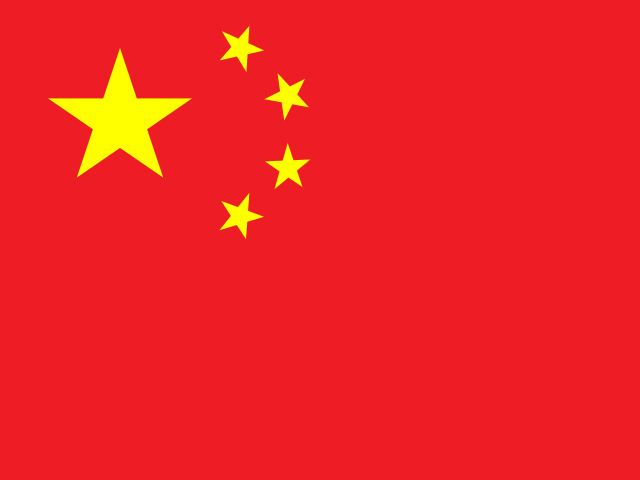
 China
ChinaBottom Line
In June 2026, China's information technology sector exhibited a clear triple resonance pattern of "AI hardware-led, policy-catalyzed, and domestic substitution accelerating." From the Arm architecture migration to breakthroughs in domestic AI chip shipments, from the supercomputer reclaiming the top spot to the storage leader passing its IPO review, each link in the industrial chain is signaling structural revaluation. Investors should overweight semiconductors, high-end PCBs, and the AI server supply chain, while also monitoring software-layer opportunities from AI agent commercialization and be cautious of the lagged impact of memory price hikes on the consumer electronics sector.
Month in Review
This month's narrative in China's IT sector revolved around a central theme: the penetration of AI infrastructure from the cloud to endpoints and the edge, coupled with substantive breakthroughs in domestic autonomy. Early in the month, NVIDIA and MediaTek jointly launched an Arm-based PC chip, marking a substantive step in the migration of computing architecture from x86 to Arm. Meanwhile, the top three domestic AI chip players (Huawei, Cambricon, and Haiguang) achieved milestone breakthroughs in shipments and profitability, validating the leap from "usable" to "good-to-use" in domestic substitution. The cyclical price increases in memory chips, while suppressing consumer electronics demand, also provided a window for phased profit improvement for domestic memory manufacturers and module makers.
Entering the second week, the market focus shifted from hardware to the software ecosystem. The large-scale deployment of AI agent technology became a core topic. The Ministry of Industry and Information Technology (MIIT) launched a special "AI + Software" initiative, and Huawei released the HarmonyOS 7 Developer Beta, accelerating the evolution of the independent operating system ecosystem. Regulatory penalties following risk exposure in critical banking information systems provided a trading logic of "short-term pressure, medium-term benefit" for the fintech sector. In the third week, policy dividends were concentrated: seven ministries jointly released an action plan for collaborative development of the platform economy, coupled with a strong rally in A-share AI hardware stocks, pushing the ChiNext index to a record high. Two major model companies, Kimi and DeepSeek, secured substantial financing, transmitting confidence from the primary market to the secondary market.
At the end of the month, the hardware sector saw several landmark events: the "Lingsheng" supercomputer returned to the top of the global TOP500 list, Changxin Technology passed its STAR Market IPO review with plans to raise 29.5 billion yuan, and the electronics industry's profits from January to May surged 103.9% year-over-year. These signals collectively point to domestic substitution entering a dual phase of capital-intensive investment and performance realization. A nearly 5 billion yuan expansion announcement by a PCB leader further reinforced the supply shortage pattern for high-end hardware.
Looking across the month, the investment theme in the IT sector was clear and coherent: AI hardware is the core driver of earnings and valuations, policy support provides a safety net for the industry, and domestic substitution opens up medium-to-long-term growth space. Market sentiment shifted from cautious neutrality at the start of the month to clear bullishness by the end, with early signs of capital rotation from hardware to software and applications.
Trajectory Analysis
| Week | Signal | Key Event | Sentiment Shift |
|---|---|---|---|
| Week 1 (2026-06-01 to 2026-06-07) | Bullish | Arm PC chip launch coupled with domestic AI chip shipment breakthrough | +2 (Neutral → Bullish) |
| Week 2 (2026-06-08 to 2026-06-14) | Bullish | AI agent market explosion and HarmonyOS 7 release | +2 (Bullish reinforced) |
| Week 3 (2026-06-15 to 2026-06-21) | Bullish | Seven-ministry platform economy policy and AI hardware leading A-share gains | +2 (Bullish continues) |
| Week 4 (2026-06-22 to 2026-06-28) | Bullish | Supercomputer reclaims top spot and storage leader passes IPO review | +2 (Bullish accelerates) |
Month-over-Month Change: Better. Compared to May, market sentiment shifted from somewhat neutral to clearly bullish, the policy environment moved from stable to more accommodative, and investment activity accelerated from moderate to active. The dense occurrence of AI hardware performance realization and domestic substitution milestone events drove the industry's valuation center higher.
Key Developments
-
NVIDIA Partners with MediaTek to Launch Arm PC Chip, Signaling Clear x86-to-Arm Migration (Week 1) — At Computex, NVIDIA, together with MediaTek and Microsoft, released the N1X Arm-based PC chip, marking a substantive step in the PC industry's transition from x86 to Arm. Portfolio implication: Focus on domestic Arm server/PC chip design companies (e.g., Phytium, Kunpeng) and the packaging, testing, and advanced packaging segments; consider increasing allocation to advanced packaging targets like Tongfu Microelectronics and JCET in the short term.
-
Domestic AI Chip Top Three Solidify: Huawei Ships Nearly One Million, Cambricon Turns Profitable for First Time, Haiguang Revenue Breaks 10 Billion (Week 1) — In H2 2025, domestic AI chip market share exceeded 40%. Huawei HiSilicon's Ascend series shipments approached one million units, Cambricon achieved breakeven, and Haiguang Information's revenue surpassed 10 billion yuan. The competitive focus is shifting from computing power to ecosystems. Portfolio implication: Recommend increasing holdings in Huawei ecosystem partners with independent software stacks; be cautious of low-end AI chip companies relying solely on foundry services; note the sustainability of Cambricon's profitability and Haiguang's customer concentration risk.
-
Memory Chips Face Rare Cyclical Change in 20 Years, Intensifying Cost Pressure on Phones/Laptops (Week 1) — Global memory chip prices continue to rise. In Q1 2026, Xiaomi's smartphone revenue fell 12.5% YoY. BOE indicated that memory price hikes are suppressing demand for laptops and smartphones. Portfolio implication: Short-term negative for the consumer electronics supply chain; recommend reducing holdings in phone/PC OEMs and mid-to-low-end panel makers. However, memory price hikes benefit domestic memory manufacturers (YMTC, Changxin Memory) and module makers (Longsys, Biwin Storage), presenting opportunities for bargain hunting.
-
AI Agent Market Explodes, Pervading Entire Software Workflow (Week 2) — According to China News Service, AI has deeply penetrated the entire software development workflow, including code generation, testing, and verification. Enterprise AI tool coverage continues to rise, with some companies achieving full employee adoption. Portfolio implication: Focus on software companies with full-stack AI agent capabilities, especially those that have achieved full internal adoption and are exporting solutions externally; consider increasing holdings in leading AI toolchain companies in the short term.
-
HarmonyOS 7 Developer Beta Officially Released, Ecosystem Undergoes Qualitative Change (Week 2) — Huawei released the HarmonyOS 7 Developer Beta on June 12, aiming to shift from the application adaptation phase to an agent-driven ecosystem leap. Portfolio implication: Huawei ecosystem partners (system integrators, application developers) will directly benefit from the expansion of the developer community and user migration; recommend focusing on software service providers and smart hardware supporting companies in the HarmonyOS supply chain.
-
Seven Ministries Jointly Release Platform Economy Collaborative Development Action Plan (2026-2028) (Week 3) — On June 18, the MIIT and six other ministries jointly released the "Action Plan for Promoting Integrated Development of Large, Medium, and Small Enterprises," aimed at enhancing the overall development level of the platform economy. Portfolio implication: Directly benefits platform leaders and software companies serving them; recommend focusing on policy-supported "Specialized and New" ("Zhuan Jing Te Xin") small and medium-sized IT service providers, whose valuation elasticity may exceed the industry average.
-
Changxin Technology Passes STAR Market IPO Review, Plans to Raise 29.5 Billion Yuan (Week 4) — Domestic memory chip company Changxin Technology passed the STAR Market listing committee review in June 2026, planning to raise 29.5 billion yuan, making it the second-largest IPO in STAR Market history. Portfolio implication: This IPO will significantly increase capital market attention on the memory chip sector and may drive valuation revaluation for supply chain supporting companies (e.g., packaging/testing, equipment, materials). Recommend positioning in relevant sub-sector leaders before the listing.
Risk Evolution
| Risk | Start of Month | End of Month | What Changed |
|---|---|---|---|
| US Chip Export Restrictions (MATCH Act, etc.) | Continuously tightening, but partially priced in | Restrictions remain, domestic substitution accelerates | Market focus shifted from "whether restricted" to "how substitution is progressing," risk premium decreased somewhat |
| Memory Price Hikes Suppressing Consumer Electronics Demand | Price hike trend confirmed, impact emerging | Price hikes continue, phone/laptop cost pressure intensifies | Risk shifted from "expectation" to "earnings realization," consumer electronics supply chain companies face further earnings downgrades |
| Risk Exposure in Critical Banking Information Systems | Not explicitly mentioned at start of month | ICBC, CCB, etc., fined, exposing disaster recovery shortcomings | Risk partially realized; bank IT outsourcing service providers face short-term pressure, but compliance rectification needs create medium-term opportunities |
Risks That Materialized: Risk exposure in critical banking information systems led to regulatory penalties, impacting short-term orders for fintech suppliers; memory price hikes suppressing consumer electronics demand continued to be reflected in revenue data from companies like Xiaomi. New Emerging Risks: No new systemic risks were clearly identified in the provided data, but continued attention is needed on the possibility of overcrowded trading in the AI hardware sector and the uncertainty of domestic chip technology iteration speed.
Sector Pulse (Monthly)
| Indicator | Start of Month | End of Month | Trend |
|---|---|---|---|
| News Flow | High | High | Stable |
| Sentiment | Neutral | Bullish | Improving |
| Policy Environment | Supportive | Supportive | Easing |
| Investment Activity | Moderate | Active | Accelerating |
Outlook: Next Month
Key catalysts to watch:
- The capital spillover effect after Changxin Technology officially lists on the STAR Market and its impact on the valuation anchor of the memory supply chain
- The release of implementation rules for the seven-ministry platform economy action plan and the realization of orders for small and medium-sized IT service providers
- Q2 earnings pre-announcements and sequential growth rates for the A-share AI hardware sector, verifying the sustainability of high profit growth in the industry
Positioning recommendation: Continue to overweight semiconductors (memory manufacturers, advanced packaging), high-end PCBs, and the AI server supply chain, as these sectors have the strongest earnings visibility. At the same time, moderately increase allocation to the AI application layer (AI agent tools, industrial vertical software), capitalizing on valuation recovery opportunities driven by policy and primary market financing. Reduce positions in consumer electronics OEMs and mid-to-low-end panels to hedge against demand-side pressure from memory price hikes. Overall, maintain over 80% positions focused on the AI + domestic substitution theme.